When Bernie Met Elton

In 1967, an ad in a London music paper brought two young strangers together. One was a lyricist from rural Lincolnshire named Bernie Taupin. The other was a piano player named Reginald Dwight, who would soon be known to the world as Elton John.
Their partnership became legendary for one unusual reason. They almost never wrote in the same room. Bernie would write his lyrics on paper and hand them over, and Elton would sit down at the piano and give them melody, harmony and shape. Sometimes a song came together in less time than it takes to drink a cup of coffee.
Bernie could not play piano or build an arrangement the way Elton could. Elton has said for decades that he could never write lyrics the way Bernie does.
So neither one ever claimed the whole song. "Your Song," "Rocket Man," "Tiny Dancer" and "Goodbye Yellow Brick Road" all carry both names. Two halves, each one useless without the other, coming together to make something timeless.
The New Wave of Bernies
Right now, something wonderful is happening. Thousands of poets, storytellers and lyricists are hearing their words turned into full, finished songs for the very first time.
For decades, if you were strictly a lyricist, your songs lived in spiral notebooks and phone memo apps. Unless you could afford demo musicians or got lucky and found a co-writer with a studio, your words stayed silent.
Today, you can bring your lyrics to a music generator, choose a style, and hear a fully produced track in minutes. That is exciting. It is creative. And it has quietly created an identity crisis in the songwriting community.
You Wrote Half the Song
I see it all the time. A writer prompts a generator with their lyrics, the track comes back, and they tell the world, "I wrote this whole song."
Let's look at that honestly.
If you wrote the lyrics, and the generator created the melody, the chords, the groove, the vocal performance and the production, you did not write 100% of that song. You wrote half of it.
And that is completely okay.
Fifty percent is not a failing grade. Fifty percent was Bernie Taupin's share of some of the greatest songs ever recorded.
Claiming the music you did not create is not only inaccurate, it can get you into trouble. The U.S. Copyright Office has been clear that human creativity is what gets protected, and material generated by a machine on its own does not. Your lyrics are yours. When you claim exactly what you created, you stand on solid ground, legally and personally.
Meet Your Elton
When you collaborate with SI (Song Intelligence) to bring your lyrics to life, you are not cheating. You are stepping into Bernie's chair, and the technology is playing Elton.
It takes your story, your heartache, your faith, your rhythm, and gives it a voice and a sound. For a lot of writers, that is the first time they have ever heard what was in their head.
That is where SongRefiners comes in. We do not judge the tools you use to hear your music. We are the seasoned ears in the room. We help you sharpen your lyrics so they hit harder, sing cleaner and tell a story real listeners connect with. And when your track comes back, we listen to the melody, the structure, the delivery and the commercial potential the way a publisher or A&R rep would, so you know exactly where your song stands and what would make it stronger.
Every great Bernie needed an Elton. And every Elton needed a Bernie.
Own Your Half
There is no shame in being a pure lyricist. Some of the most celebrated songwriters in history never played a note on stage.
If you write the words and collaborate with SI for the music, here is how to carry it:
1. Be proud of your lyrics. Make them so honest, sharp and memorable that nobody can ignore them. That is your half, so make it your best.
2. Be transparent. Tell people, "I wrote the lyrics, and I collaborated with Song Intelligence on the music." Listeners respect honesty far more than posturing, and so does the industry.
3. Keep refining. A generator can produce chords all day long, but it has never felt heartbreak, joy, faith or loss. That part only comes from you, and it is the part that makes a song matter.
Bernie needed Elton. Elton needed Bernie. Neither one took the whole song, and together they made history.
Welcome to your co-writing room. Write your half with everything you have, and let's refine it until it is undeniable.
Bring your lyrics or your finished track to SongRefiners and find out what your half is really worth.
Related posts
The Same Four Chords
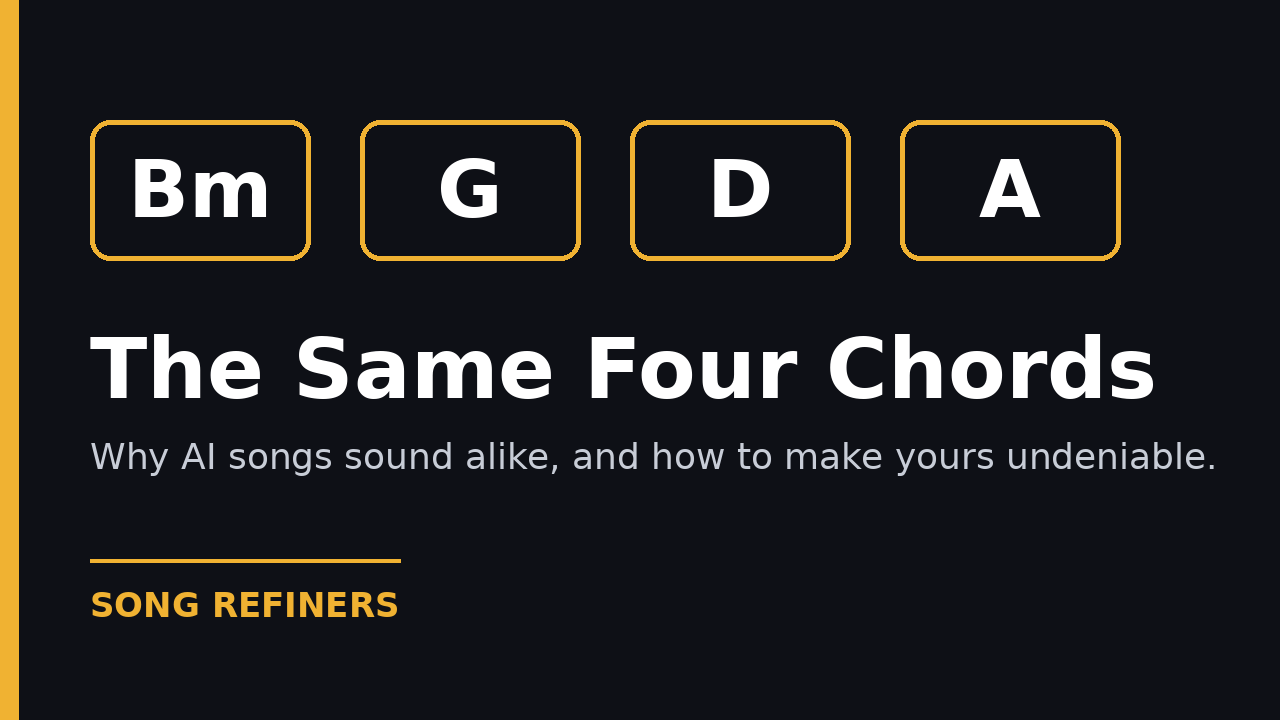
AI songwriting tools keep reaching for the same structure, the same Bm-G-D-A chord loop, and the same climbing melody, which gives you a competent song that sounds like everyone else's. Their vocals also rarely breathe, so on mid- or up-tempo songs, keep your lyric lines short enough for a human to sing. Song Refiners shows you where your song goes generic and helps you make it yours, which is how a good song becomes undeniable.
The First 15 Seconds: What Publishers and Music Supervisors Actually Hear
Gatekeepers decide in seconds, not minutes. Here is what a publisher or music supervisor is really listening for in the first 15 seconds of your song, and why most intros fail the test.
The Second Verse Curse: How to Keep Your Song's Momentum Going
Your first verse sets the scene and your chorus lands the hook. Then verse two shows up with nothing to say. Here is how to beat the second verse curse and keep the story moving.
Why Your Friends Lie About Your Songs (And Where to Get the Truth)
Your friends say every song is great. The industry says nothing at all. Neither one helps you grow. Here is why honest feedback is so hard to find, and where to actually get it.
How to Know If Your Song Is Good Enough to Record
Before you book studio time or hire a demo singer, run your song through this checklist. Most songs that fail in the studio failed on the page first.
The First 15 Seconds: Why Publishers and Music Supervisors Skip Your Song
Gatekeepers listen to hundreds of songs a week and stop most of them in seconds. Here is what happens in that window and how to survive it.